Week 1
1
Jan 25
AME 294 Topic: Interactive Visual Environments
What is this class about? Is this an art class? What is an interactive system? Who are we, where are we from, what are the majors and why are you taking this class?
Assignment 1:
Gather 10 mug shots of your own for averaging. Who do you pick? Make a 1000 by 1000 image


Assignment 1b:
Gather 10 other shots of anything at all you want to average. Cars, water fountains, clouds, toes?

Assignment 1c:
Bring your digital camera to class next week
Reading Assignment:
“Bruce Mao’s Manifesto for Growth”
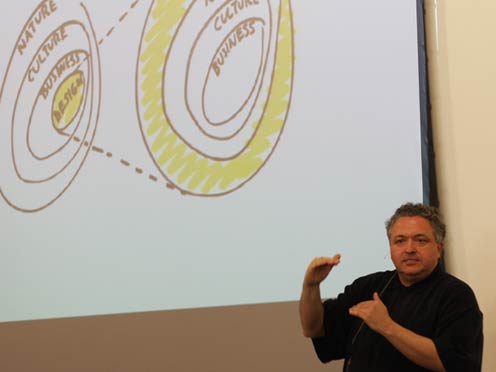
After reading this article i was really excited to meet Bruce mau at Expossed 2010 here are a few of my favs:
2. Forget about good.
Good is a known quantity. Good is what we all agree on. Growth is not necessarily good. Growth is an exploration of unlit recesses that may or may not yield to our research. As long as you stick to good you’ll never have real growth.
3. Process is more important than outcome.
When the outcome drives the process we will only ever go to where we’ve already been. If process drives outcome we may not know where we’re going, but we will know we want to
be there.
4. Love your experiments (as you would an ugly child).
Joy is the engine of growth. Exploit the liberty in casting your work as beautiful experiments, iterations, attempts, trials, and errors. Take the long view and allow yourself the fun of failure every day.
12. Keep moving.
The market and its operations have a tendency to reinforce success. Resist it. Allow failure and migration to be part of your practice.
13. Slow down.
Desynchronize from standard time frames and surprising opportunities may present themselves.
14. Don’t be cool.
Cool is conservative fear dressed in black. Free yourself from limits of this sort.
17. ____________________.
Intentionally left blank. Allow space for the ideas you haven’t had yet, and for the ideas
of others.
22. Make your own tools.
Hybridize your tools in order to build unique things. Even simple tools that are your own can yield entirely new avenues of exploration. Remember, tools amplify our capacities, so even a small tool can make a big difference.
32. Listen carefully.
Every collaborator who enters our orbit brings with him or her a world more strange and complex than any we could ever hope to imagine. By listening to the details and the subtlety of their needs, desires, or ambitions, we fold their world onto our own. Neither party will ever be the same.
34. Make mistakes faster.
This isn’t my idea – I borrowed it. I think it belongs to Andy Grove.
35. Imitate.
Don’t be shy about it. Try to get as close as you can. You’ll never get all the way, and the separation might be truly remarkable. We have only to look to Richard Hamilton and his version of Marcel Duchamp’s large glass to see how rich, discredited, and underused imitation is as a technique.
39. Coffee breaks, cab rides, green rooms.
Real growth often happens outside of where we intend it to, in the interstitial spaces – what Dr. Seuss calls “the waiting place.” Hans Ulrich Obrist once organized a science and art conference with all of the infrastructure of a conference – the parties, chats, lunches, airport arrivals – but with no actual conference. Apparently it was hugely successful and spawned many ongoing collaborations.
40. Avoid fields.
Jump fences. Disciplinary boundaries and regulatory regimes are attempts to control the wilding of creative life. They are often understandable efforts to order what are manifold, complex, evolutionary processes. Our job is to jump the fences and cross the fields.
41. Laugh.
People visiting the studio often comment on how much we laugh. Since I’ve become aware of this, I use it as a barometer of how comfortably we are expressing ourselves.
Read the full Manifesto here
- May 3rd, 2010
- AME 294 Topic: Interactive Visual Environments
- No comments
- #